
Plastic PE Gloves: Choosing Sizes for High-Volume Workplaces
Oct 31, 2026
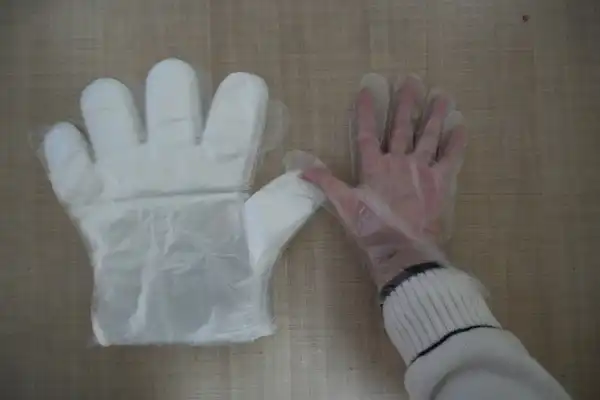
Choosing sizes for Plastic PE Gloves https://www.jldplastic.com/disposable-gloves/plastic-pe-glovescomes down to matching flat glove dimensions to the hands on your floor, not to a letter printed on a box. For high-volume sites, the workable answer is a four-size stock range — S at 23 × 25 cm, M at 24 × 26 cm, L at 25 × 27 cm, and XL at 26 × 28 cm — ordered in 100-piece bags at a 0.6–0.8 丝 film gauge. I have watched a single size correction do more for glove waste than any training poster. Here is how to make that correction hold.
Understanding Plastic PE Gloves and Their Role in Busy Workplaces
Polyethylene gloves come in handy when you only need a shield for a short time. The film, the surface, and the papers can all be read to find out more about fit and cost than just the price per box.
What Polyethylene Film Brings to a Disposable Glove
High-density polyethylene makes a thin film strong. Lines that blow film form the melt into a tube. As the tube cools, hot machinery joins the ends together to make a glove shape. If the thickness is between 0.6 and 0.8 , or 6 and 8 microns, it makes a light barrier that can bend and have a slight crinkle. When you source, there are two things that are key. It doesn't have any latex proteins or powder in it, so Type I allergies won't happen. Because the film stops water and grease from moving, it's also easy to work with quickly. I don't use it as a protective glove because it doesn't stand up to chemicals or heavy wear. Instead, I use it to keep things clean.
Where the Embossed Surface Pays Off
It's easy to move a smooth film over wet surfaces, and it sticks to wet skin. That touch is broken by the non-slip design, which is also called a diamond or hammered finish. This is because each raised point pulls the film off your palm a little, making it harder where your fingers touch something like a dye bottle, a shrimp shell, or a cleaning cloth. To do my field test, just wet your hand, put on gloves, and try to pick up a plastic bag. Easy film slips and raised film grips. Hairdressers keep gloves with drawings on them next to the color bowls because of this difference. Caterers who are going through trays of fish ask for texture.
Reading the Specification Before You Commit
There is a stock specification that I use that says the following about the film: it is made by automatic heat pressing and has a raised, non-slip surface. It is safe and non-toxic. A bag has 100 pieces. You can cook with it (like when you eat fish), clean lightly with it, and color your hair with it. If anything, it's just a cheap way to keep your hands clean. Find out where that statement comes from. Everything is taken care of for the US market by an olefin polymer food-contact statement that is tied to FDA 21 CFR 177.1520. Tests for movement under EN 1186 mostly support what the EU says. The gauge and seal strength should have stayed the same during the run, as shown by the batch record.
Why Wrong Glove Sizes Cost More Than They Save
Size mistakes on invoices don't happen very often. People who don't wear gloves during their shift, extra bills, and cuffs that are split are all signs of this.
The Hidden Cost of a Loose Cuff
Because they are too big, gloves bunch up at the palm and leave a flap at the wrist. That flap pulls open a seam every time it hits something. With the drawer handles, tray edges, and mixing guards, it does both of these things. Crumbs and liquid can also get stuck in loose film, which turns a glove that is meant to protect into a carrier. The FDA Food Code says that people who work with food must replace their gloves whenever they get dirty, tear, or switch jobs. Every choice that could not have been made saves money in wasted time, goods, and money. Teams often double-glove when there is a lot of breaking, which means they use more gloves without making the fit better.
What Happens When Gloves Run Tight
It hurts your hand to wear gloves that are too small. The person wearing them spreads their hands wide, and the web between their thumb and index finger pulls. This makes their fingers curl against the force. There is also stress on the heat-sealed seam. A rule from OSHA called 29 CFR 1910.138 says that companies must give workers the right PPE for the job and the person. These two things are not met by a glove that breaks in the middle of a task. It takes longer to work with tough film, and tired hands fall off. People took off their gloves to finish a tray and then worked at the next station without gloves on, which is not what a quality manager wants to see.
Measuring Hands Without a Fitting Room
You do not need a fitting room for this to work. All you need is a ruler and twenty minutes. How long is your hand? From where your wrist bends to the tip of your middle finger, measure. How big is your hand? If you don't count your thumb, measure across the widest flat part below your fingers. Use the hand that is stronger. Find volunteers from a range of shifts and areas instead of depending on just one. This is because the number of men and women on the crew and their hand sizes are linked. Put the people on a sheet and number them. Then sort them into two groups that can hold the most people each. These groups give you your starting order.
Choosing Plastic PE Gloves: A Size Guide for Bulk Buying Teams
Know the hands before you try to use the library. There are four sizes of this stock that should work for most sites. It says on the bag how much each size grows.
The Four Stock Sizes and What the Numbers Mean
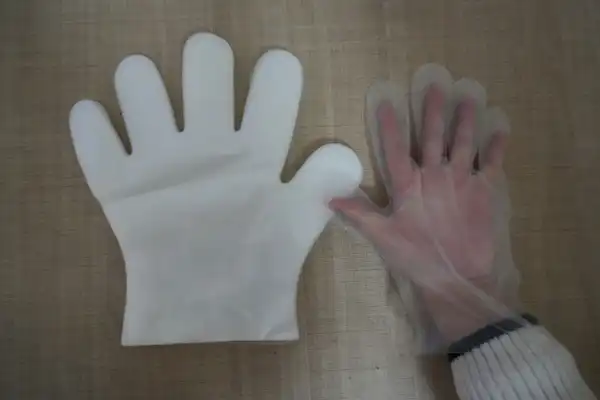
Tyrel gloves and nitrile gloves are not the same size. There are two sizes of flat Plastic PE Gloves: S is 23 cm by 25 cm, M is 24 cm by 26 cm, L is 25 cm by 27 cm, and XL is 26 cm by 28 cm. Nitrile charts show how many millimeters a letter is apart from a palm of the hand. The pattern doesn't have any jumps because each step up adds one centimeter to both sides. To make a firm choice, lay out a sample and compare it to the hand that was measured. The cuff should go past the wrist bone without folding back. It's not the same thing as size because the scale stays the same from 0.6 to 0.8 mm all the way through the range.
Matching Size to Task and Change Frequency
The task shapes the size just as much as the hand. A tighter fit is fine at a sandwich stand where gloves are changed every few minutes because the glove can be taken off before it rubs. So that they can wear the same pair from one bathroom to the next, the knuckles need to be able to move around. The cuff also needs to stay in place. People who work in catering and handle shellfish need shells that are rough and bendy so they can pinch and twist them. Hair dye needs a tight cuff so it doesn't run down the wrist. I set each station to a certain size and gauge, and supervisors could switch as long as they wrote down a reason.
Building a Size Mix Into a Purchase Order
A second order is often made soon after a first order based on one size. Three habits help the mix stay true.
- Run a test run before the first full container comes in. Give one area two sizes for a week. Then, add up how many pieces each worker pulls and see how it compares to the number of workers. It only costs a few bags of stock and will be useful for a week instead of a meeting room guess.
- Do not divide the order by how much will fit in the warehouse, but by how much will be used. If it's only used five times a day, small shouldn't take up a third of the box. Store items in 100-piece bags so that a boss can restock a station without having to open a box. Then, look over the split again every three months because the number of employees changes.
- While the amount is being talked about, ask about prints and packing that are made just for you. Distributors can sell gloves with their own brands and bags with their own labels. If a plant makes its own films, it doesn't need to add a second provider, a second set of quality checks, or a second wait time. Instead, it can match the art to the order of the films.
Together, these habits turn a glove line from a recurring guess into a managed item.
Comparing Plastic PE Gloves With Nitrile, Vinyl and TPE
Some tests show that plastic isn't the best choice. It's profitable to sell it for the wrong job, so the comparison needs a clear answer.
Where Polyethylene Wins on Cost per Use
Plastic PE gloves aren't very expensive, but they cost a lot each time they're used. Not as fast as a machine can blow, press, or bag them, and the raw material is less expensive. For quick jobs like making a sandwich, painting, wiping down the counter, or putting fruits and vegetables in bags, that works. Polyethylene doesn't have any natural rubber proteins in it, so it's good for people who are allergic to latex. Gloves need to be changed a lot during a shift. These little things add up over the course of a year. Do not put them near chemicals as they will not be able to handle acid, heat, or sharp edges.
Where Nitrile and Vinyl Take Over
A small hole can be dangerous when working with chemicals, in the lab, or anywhere else. That's why nitrile socks are worth the money. Many oils and chemicals don't hurt it; it works better on holes, and it fits close enough for fine work. Vinyl, on the other hand, is softer than polyethylene and easier to wear for longer events. That being said, it doesn't stand up to some chemicals as well and can make chloride build up in waste streams. TPE, which costs more than plain PE, has a better fit and more flexibility. Different types of these materials are better for different jobs. It's usually safer and cheaper to use a mix of materials than just one type.
A Quick Test for Your Own Floor
Most of the important questions can be answered in five questions. How long does one pair last? Do you need to use acids, chemicals, or hot surfaces? Do they need to be able to use their fingertips to feel small parts? How many pairs does a shift take up? What does everyone on the team think about latex? If the answers are short, dry, full of words, and don't have any rubber in them, Plastic PE Gloves is the right answer. If any answer cites chemicals, heat, or holes as a risk, move up to nitrile. Since the station staff knows how long gloves really last, I test them on bosses instead of buyers by themselves.
Safety, Compliance and Waste Handling at Volume
When it comes to rules and waste, a cheap glove can cost a lot. You can do both, and the first thing you should do in both is talk to the service.
Paperwork Worth Requesting
Do not get the papers after the first shipment; get them before it. For the US market, that means a food-contact statement that talks about FDA 21 CFR 177.1520. This is the rulebook section that talks about olefin polymers that are used to package food. For people in the EU, the food-contact claim is backed up by test data under EN 1186. There are proofs of good quality management that shows how the plant works. There is an ISO 9002 mark and a QS mark on our factory. A batch certificate should show the film gauge, the seal strength, and the amount of water that leaked at an agreed-upon AQL. People who respond quickly to these pleas usually have tighter rules.
Storage, Shelf Life and Batch Consistency
It takes time for polyethylene to break down. Heat and UV light break down the polymer chains. This means that a box left by a loading dock in the summer will tear long before the date code says it should. Keep bags off of concrete floors and out of the way in a cool, dry room. Change the order of the stuff that comes in and goes out as well. That's how it should be kept, and it should last between three and five years. It's not just your age that counts. Open one bag from each group and check that the pattern is even, the size matches the order, and the edges of the cuffs are easy to pull apart.
Cutting Waste Without Cutting Protection
Gloves that are worn in places they don't do anything, are the wrong size, or aren't tight enough are the three main causes of glove waste. To win for the least amount of money, set the size. You don't have to grab a bunch of gloves because they come out one at a time. A station will change gloves sometimes even if they don't need to. Some buyers now ask sellers for options with recycled material or ways to get their old film back. Polyethylene film can be returned in places where it is collected. Ask your seller to show you what they can prove instead of just taking a name off of a brochure.
Conclusion
Choosing the right size of Plastic PE Gloves starts with measuring the glove dimensions and matching them to the needs of your workforce. Available sizes typically range from S (23 × 25 cm) to XL (26 × 28 cm), although exact dimensions may vary by manufacturer. Since the flat width and length of Plastic PE Gloves directly affect fit and ease of use, buyers should compare actual measurements rather than relying on size labels alone. To identify the most suitable option, provide employees in each department with samples in two different sizes and ask workers across different shifts to evaluate comfort, coverage, and ease of movement. This practical fitting process helps businesses estimate the quantities required for each size before placing a bulk order. Properly sized Plastic PE Gloves are suitable for tasks such as food serving, hair coloring, and light cleaning when the material is compatible with the intended application. However, standard polyethylene gloves should not automatically be considered suitable for handling harsh cleaning chemicals, sharp objects, or tasks requiring strong puncture resistance. Before purchasing Plastic PE Gloves for food-handling operations, verify the applicable food-contact documentation and ensure that the product meets local regulatory requirements. Proper storage is equally important: keep Plastic PE Gloves in their original packaging, away from excessive heat, direct sunlight, and UV exposure that could affect material quality. In addition, inspect each incoming batch for film thickness, dimensional consistency, and legible packaging information to help maintain reliable quality standards. By checking size specifications, application requirements, documentation, and batch consistency, businesses can select Plastic PE Gloves that support workplace hygiene, efficient operations, and consistent glove use throughout every shift.
FAQ
How do I convert a nitrile size to a PE glove size?
There is no safe way to convert. On charts for nitrile gloves, the palm width is given in millimeters. On charts for flat plastic gloves, however, the palm width and length are given in centimeters. Carefully measure the hand and then match the size to a flat sample from the stock range.
Is 0.6–0.8 丝 thick enough for food handling?
Microns are about the same as 0.018 mm, which means this film is between 6 and 8 microns thick. Putting food on plates, bagging it, and serving it are all short-term food jobs that are good for it. It's too thin to handle heat, liquids, edges that are too sharp, or use for a long time.
Can we order mixed sizes and custom printing?
When people order the same thing, they often ask for different sizes or a custom print. The standard pack is still 100 pieces per bag. As soon as possible, find out the minimum quantities and lead times. This is because the shipping window is based on when the print plates and films are due.
Do these gloves work for hair dyeing?
Yes, of course. The cuff keeps the dye off the wrist, and the raised part can hold bottles. Because polyethylene is only used once unlike gloves that can be used again and again, switch pairs between clients.
Ready to Fix Your Sizes? Talk to SYM About Plastic PE Gloves
Polyethylene film has been SYM's business for more than 20 years. It is based in Rizhao, China. More than 100 people work at their 8,600-yuan plant, and they ship to more than 40 countries. Their factory is ISO 9002 and QS-approved. We keep sizes S to XL of Plastic PE Gloves in stock, with 100 gloves per bag. We can print on them in any way you want, and we'll get back to you within 24 hours. jinlidasuliao@zohomail.cn or jinlida.aixdb.cn are both ways to get in touch.
References
1. U.S. Food and Drug Administration. Code of Federal Regulations, Title 21, Part 177.1520 — Olefin Polymers. U.S. Government Publishing Office, 2024.
2. U.S. Food and Drug Administration. Food Code 2022. FDA, 2022.
3. Occupational Safety and Health Administration. Hand Protection, 29 CFR 1910.138. U.S. Department of Labor, 2023.
4. ASTM International. ASTM D882 — Standard Test Method for Tensile Properties of Thin Plastic Sheeting. ASTM International, 2018.
5. ASTM International. ASTM D5151 — Standard Test Method for Detection of Holes in Medical Gloves. ASTM International, 2019.
6. European Committee for Standardization. EN 1186 — Materials and Articles in Contact with Foodstuffs: Plastics. CEN, 2022.

Send Inquiry
You may like